
Why Do Ghostwritten Manuscripts Stumble at the Formatting Handoff?
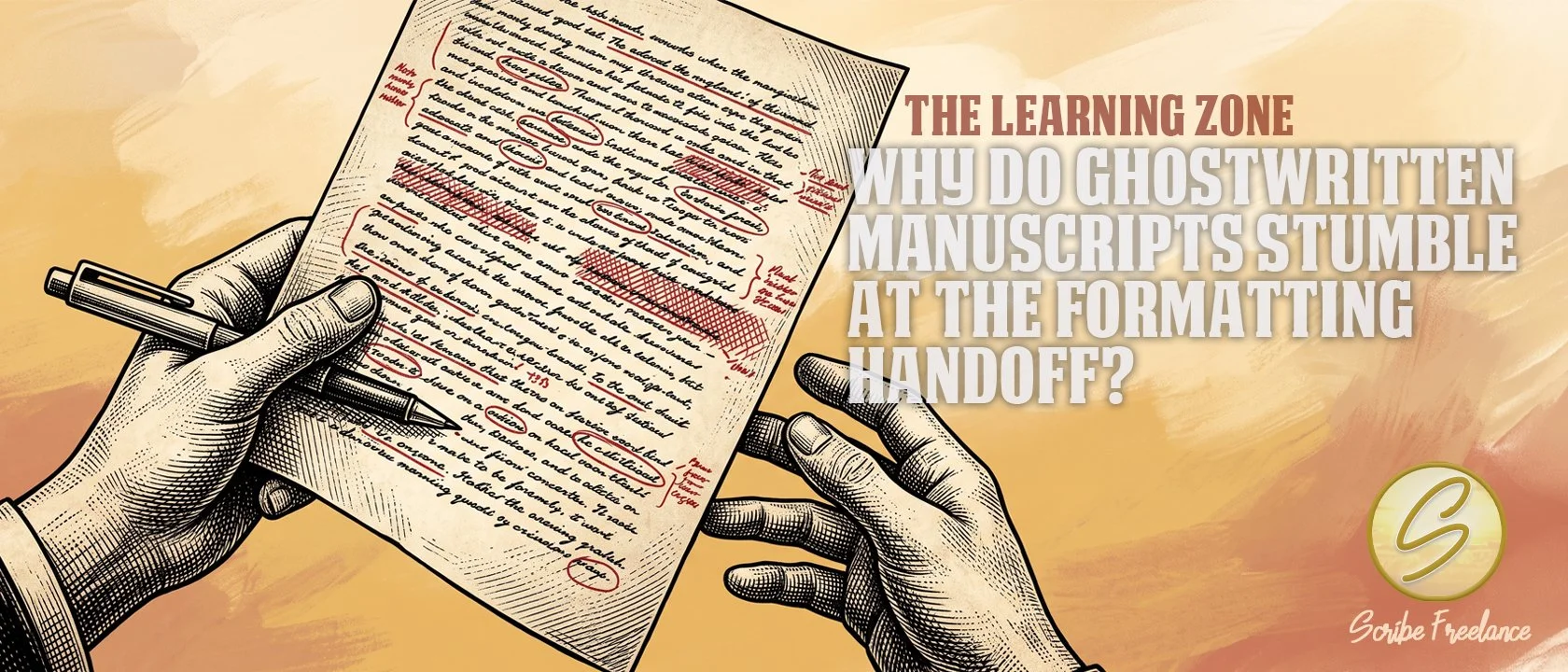
A faithful voice on the page is only half the job. The other half gets tested at the handoff.
A ghostwritten manuscript can read exactly like the author it was written for and still not be ready for a formatter’s desk. That’s not a contradiction. A ghostwriter’s job is capturing the author’s ideas faithfully, not preparing a file that’s been tested against structure.
My name is Daniel J. Middleton, and after close to two decades in book design, the mistakes I see most often aren’t about talent — they’re about a process nobody explained. A full copyedit that landed on my desk right after a ghostwriter finished made this particular pattern impossible to miss.
This article covers where that handoff tends to break down, using that real project as the walkthrough, and what to build before layout starts so it doesn’t happen to your manuscript.
Why Does a Ghostwritten Manuscript Still Need Its Own Handoff Checkpoint?
A ghostwriter can carry an author’s voice and ideas onto the page with real skill and still hand off a manuscript that has never been tested against structure. That gap doesn’t announce itself early. It shows up later, and it tends to look like a formatting problem when it’s actually an unresolved content or consistency issue finally getting noticed.
A ghostwriter’s job ends at capturing the author’s ideas on the page. Getting the book across the finish line is the editor’s and designer’s job.
That’s not a knock on ghostwriting. A ghostwriter typically delivers something like 80 percent or more of an author’s ideas in finished form. But 80 percent finished and handoff-ready are two different things, and treating them as the same one is where projects stumble.
What Actually Goes Wrong at the Ghostwriter to Formatter Handoff?
A recent memoir project made the pattern concrete. The author wasn’t a seasoned writer, so a full copyedit was picked up right after the ghostwriter finished, and three separate problems surfaced in the process.
The core subject was never actually locked. The ghostwriter told a sweeping version of the story rather than pinning down the real spine of the memoir. Once that became clear, roughly 30,000 words had to come out. The material wasn’t wasted — it became downloadable bonus content on the author’s own website — but the manuscript needed the cut to hold together as a book.
Structure only revealed its problems at layout. Several chapters had to be reordered once the author saw the real design, and the callouts needed real editing too. Not because anything in the manuscript was wrong, but because a ghostwriter working from an author’s ideas has no reliable way to preview how those ideas will actually read once they’re structured. That’s the same pattern covered in why a nonfiction manuscript reads differently once it’s designed — a manuscript can’t be fully judged until it exists as a real, laid-out book. This project is a direct, real-world case of exactly that.
Voice and formatting were inconsistent throughout. Speech patterns, spelling, and manuscript formatting all needed active harmonizing. That’s expected, not a flaw in the ghostwriter’s work. Formatting consistency and voice harmonizing were never the ghostwriter’s job to begin with.
Why Build a Style Sheet Before Layout Starts?
The fix for that third problem is also the fix that should happen before either of the other two gets discovered the hard way: build a style sheet at the start of the handoff, not partway through it.
On this project, that meant real decisions, not a generic rulebook applied on autopilot. The base was the Chicago Manual of Style, but a conversational, first-person memoir doesn’t behave like a technical manuscript, so the number rules got built around that voice on purpose.
Ages and durations stayed numerals — “6 years old,” a “10-year career” — while simple counts stayed spelled out, “two vivid memories,” “eleven children,” because collapsing both into one blanket rule would have made the narration read more clinical than the author ever sounded. Em dashes, quotation formatting, and how possessives behaved all got the same treatment: decided once, in writing, instead of guessed at sentence by sentence.
A style sheet built like that, before layout starts, catches inconsistencies while they’re still cheap to fix, and it keeps the author’s actual voice intact instead of quietly overriding it with generic style defaults. Waiting until they show up in a proof means fixing them under pressure, on a schedule that no longer has room for it.
What Should You Actually Do With a Ghostwritten Manuscript Before Formatting Starts?
Treat the handoff as its own checkpoint, not a formality on the way to layout. Confirm the core subject is actually locked before anyone starts thinking about pages. Build the style sheet immediately instead of assuming the manuscript arrives internally consistent. And go in expecting that chapters and callouts may still move once the design is real — that’s not a sign anything went wrong upstream, it’s what a design pass is supposed to reveal.
If you’re working through a ghostwritten manuscript and want a second set of eyes before it goes to layout, get in touch and we’ll look at where it actually stands.