
Editing Before Formatting or After: Which Order Actually Works?
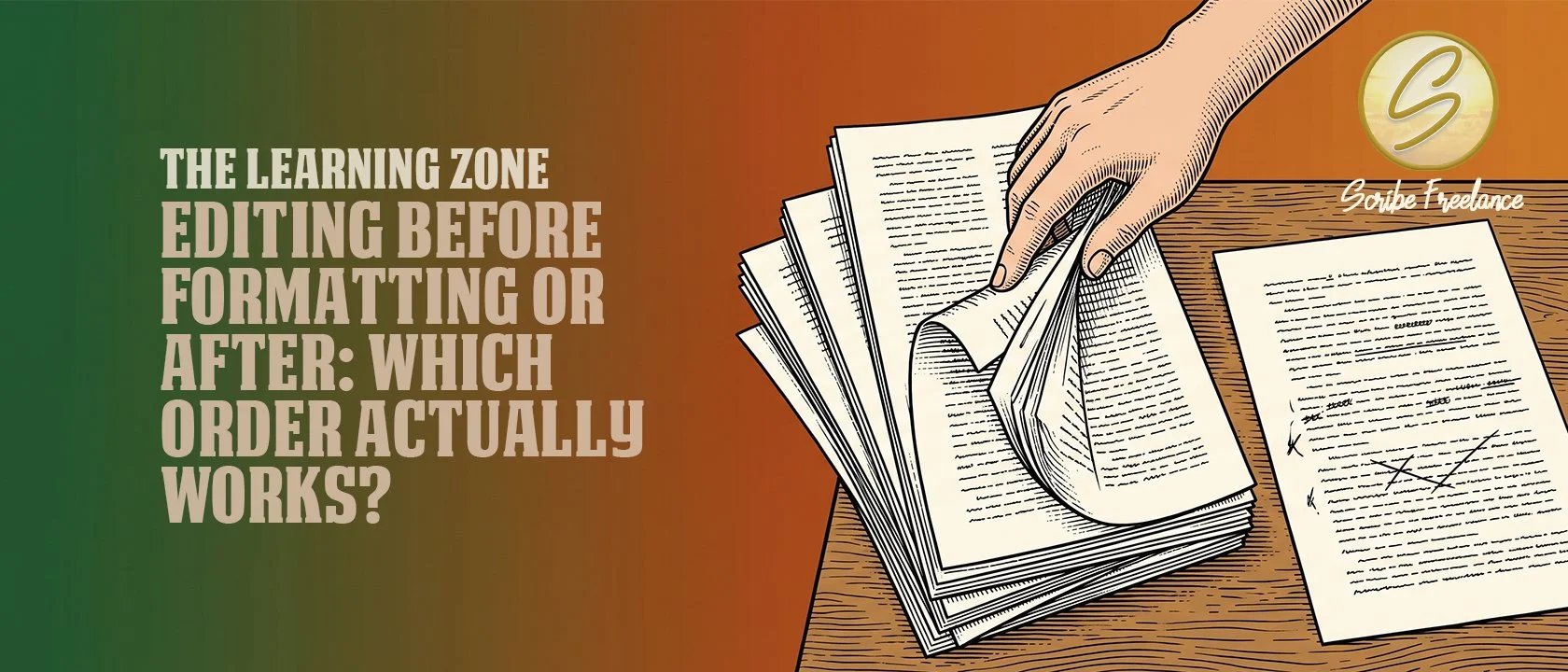
Formatting locks a shape around the words. Get the words settled first, and the shape only has to get built once.
Edit first, format second — in that order, with one narrow exception. Formatting a manuscript before the edits are finished sets up rework: any substantive edit that lands after layout risks reflowing text, which can move page breaks and knock out anything tied to a specific page number.
I’m Daniel J. Middleton, and after over two decades of editing and designing books for authors and publishers, I still start every project the same way — find out what’s actually finished before touching layout.
This piece walks through why formatting first feels like the natural move, what reflow actually breaks once it happens, and the one kind of edit that’s fine to run after layout is already locked.
Why Does Formatting a Manuscript First Feel Like the Right Move?
There’s something to look at. A formatted page reads like progress in a way a marked-up manuscript doesn’t — margins set, chapter headers styled, something that finally looks like a book instead of a Word document.
That instinct is understandable. It’s also backward. Formatting is the layout locking itself around a specific, final version of the text — and if that text isn’t actually final yet, the layout is locking around the wrong thing.
What Does Reflow Actually Break Once a Manuscript Is Already Formatted?
Reflow is what happens when text shifts inside a formatted document — a cut paragraph, an added sentence, a restructured section — and everything downstream of that shift has to absorb it. Pages don’t hold their content anymore. A chapter that ended on page 142 might now end on 139, or 146.
That sounds minor until you total up what’s built on page numbers. A table of contents. An index, if the book has one.
Cross-references that point a reader from one chapter to another by page. Running heads, if they carry a chapter title that no longer lines up with what’s actually on that page after the shift. None of it breaks loudly — it just quietly stops matching, and someone has to recheck all of it by hand.
In production work spanning both sides of this — editing manuscripts and laying them out — the same pattern shows up constantly: a manuscript formatted early, edits landing afterward, and the layout having to absorb changes it was never built to expect. On one recent index correction, the fix meant isolating each specific change rather than re-running the whole layout, specifically to avoid the kind of text-wrap shift that throws off page count elsewhere in the book.
Should You Edit Before or After Formatting a Manuscript?
Before. Substantive editing — copy editing, comprehensive editing, a rewrite, whichever tier the manuscript actually needs — should be complete and locked before formatting starts.
Not roughly done. Not “final draft, probably.” Locked, in the sense that no one expects the text to move again.
Once that’s true, formatting only has to happen once, against a text that isn’t going anywhere. That’s the whole advantage: one layout pass instead of a layout pass, an edit, and a second layout pass to absorb it.
This matters just as much when editing and formatting are two separate people. If an author hands a manuscript to a formatter before the editor has actually signed off, the formatter is building on a version of the book that’s about to change out from under them — through no fault of their own.
Formatting decides how the words sit on the page. Editing decides what the words are. Settle the second one before you start the first, and the page only has to get built once.
Does Every Edit After Formatting Cause the Same Reflow Problem?
No — this is the exception worth naming so the rule doesn’t overclaim. A proofread pass after formatting is normal, and expected. Proofreading catches typos, punctuation slips, and small mechanical errors — it doesn’t restructure sentences or cut and add material, so it doesn’t meaningfully reflow the text the way a comprehensive edit or a rewrite would.
The order problem is specifically about substantive edits landing after formatting — not about any correction at all showing up after layout. A light post-formatting proofread is a normal last step, not a violation of the sequence.
This isn’t the only checkpoint on the way to a finished book, either — a clean edit and a genuinely print-ready manuscript aren’t automatically the same thing, which is its own separate check worth running. But the editing-before-formatting order is the one that decides how many times layout has to happen at all.
What Should You Check Before You Format Your Manuscript?
Confirm the edit is actually done — not close, not “final for now,” genuinely locked — before formatting starts. If comprehensive editing is still in progress, or a beta round hasn’t wrapped, that’s the signal to hold formatting a little longer rather than get a head start on it.
If editing is the stage you’re not sure is actually finished, the service rates page breaks down what each tier covers, so you can tell when a manuscript is done enough to hand off to layout — not just done enough to look at.