
Human Editing vs. AI Grammar Tools: What’s the Actual Gap?
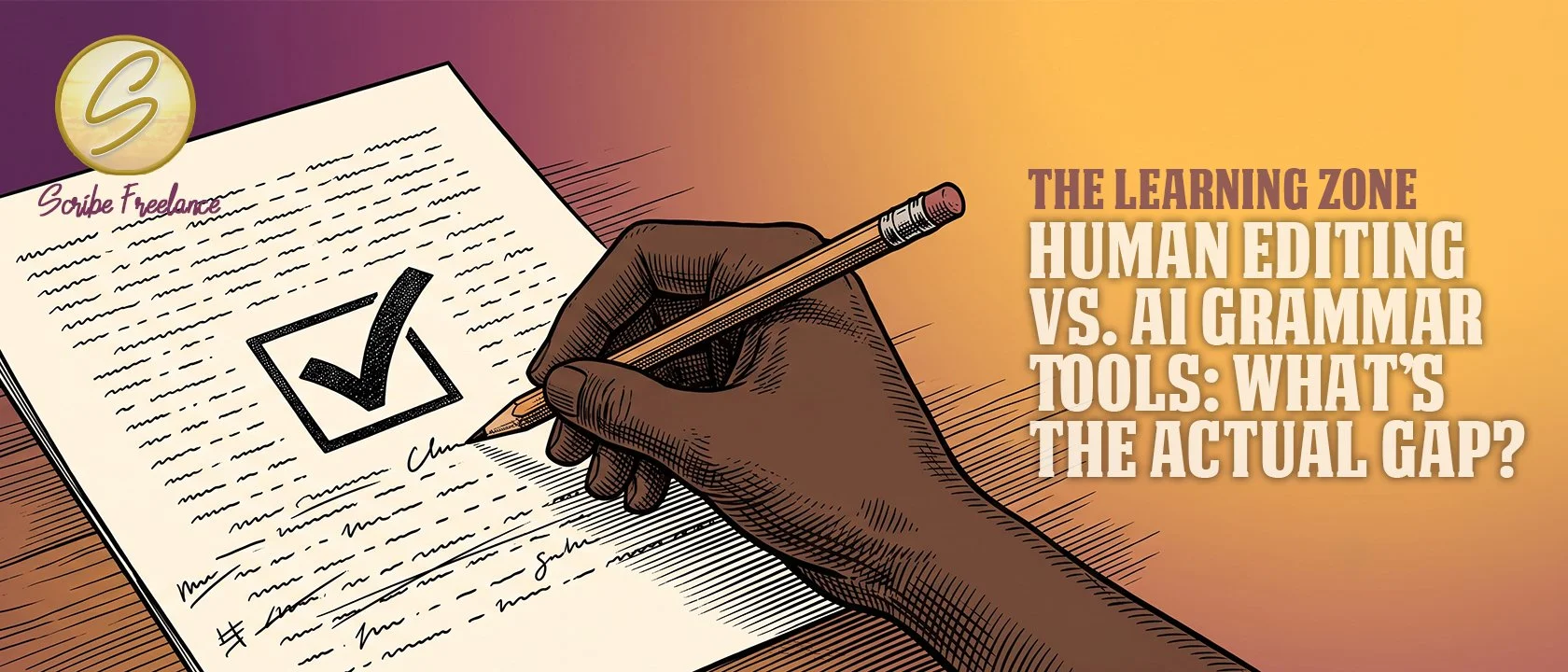
A checkmark confirms the sentence is correct. Whatever comes after that is still a judgment call.
A grammar checker can confirm a sentence is correct. It can’t tell you whether that sentence belongs in the book at all — that's the real gap between what an AI editing tool catches and what a human editor does. A manuscript that runs clean through one of them looks finished. It usually isn’t.
I’m Daniel J. Middleton, and my editing work goes back to 2002, when a Brooklyn-based press first hired me to proofread a novel — over two decades of learning exactly where a manuscript still needs work before it’s ready for readers.
This piece draws the actual line: what these tools genuinely catch, what still needs a human editor’s judgment, and why passing the check isn’t the same as being edited.
What Are AI Grammar Tools Actually Good At?
Genuinely useful things. Spelling. Common grammar errors — subject-verb agreement, dangling modifiers, comma splices. Some style-consistency flagging, like catching a character’s name spelled two different ways, or a tense that slips mid-paragraph. Sentence-level suggestions for wordiness or repeated phrasing.
That’s real value, not a token concession before dismissing the tools. A manuscript that’s already been run through one of these before it reaches an editor arrives cleaner, and that’s worth something.
Why Doesn’t a Clean Grammar Check Mean a Manuscript Is Edited?
Manuscripts increasingly arrive already run through a grammar checker — clean at the sentence level before anyone else touches them. The issues that remain are consistently the kind these tools were never built to catch: a subplot that drops without resolution, a character’s motivation that doesn’t hold up across three hundred pages, an argument that circles back to the same point twice because the outline shifted mid-draft.
None of that trips a grammar flag. Every sentence involved can be perfectly correct on its own.
What Actually Requires Human Editorial Judgment?
Whether a passage still serves the book’s argument or story, once everything around it has changed. Whether something stays factually or internally consistent across a manuscript long enough that no single read holds it all in memory. Whether an unusual sentence is a deliberate stylistic choice or an actual error — a call that depends on knowing the writer’s voice, not just the rule.
A grammar checker reads one sentence at a time. An edit has to hold the whole book at once.
Structural and organizational judgment sits in the same place. Deciding a chapter is in the wrong order, or that a scene needs to land earlier than it currently does, means seeing the manuscript as a whole — context no line-level tool has access to.
Are Newer AI Editing Tools Starting to Close the Gap With Human Editors?
Some are trying. A newer generation of AI-assisted manuscript tools has started attempting broader feedback — flagging pacing, or tracking a character across chapters, not just correcting sentences. That category is moving fast enough that anything written here about it would likely be stale within the year, so it’s worth checking a given tool’s current capability directly rather than trusting a claim printed months earlier.
What hasn’t changed yet: even the tools reaching further describe themselves as getting a manuscript most of the way there, not replacing the judgment call at the end.
What Should You Actually Do With an AI Grammar Tool?
Use it. Run the manuscript through one before it goes anywhere else — it’s a legitimate, useful first pass, and there’s no reason to pay a human editor to catch a comma splice a tool would’ve flagged for free. Just don’t mistake a clean report for a finished manuscript.
Once the mechanical layer is handled, the real question is which tier of human editing the manuscript still needs — a different decision than whether it needs editing at all. How to decide between a proofread, a copyedit, a comprehensive edit, and a rewrite walks through exactly that call.
The same point holds across this whole series of articles: proofreading, copy editing, comprehensive editing, and rewriting each reach something different, a clean edit still isn’t automatically print-ready, and now a clean grammar-checker pass isn’t automatically an edit either. Each checkpoint catches a specific thing. None of them substitutes for the next one.
If you’re not sure which tier your manuscript is actually at, the service rates page breaks down what each one covers.