
Proofreading vs. Copy Editing: What’s the Real Difference?
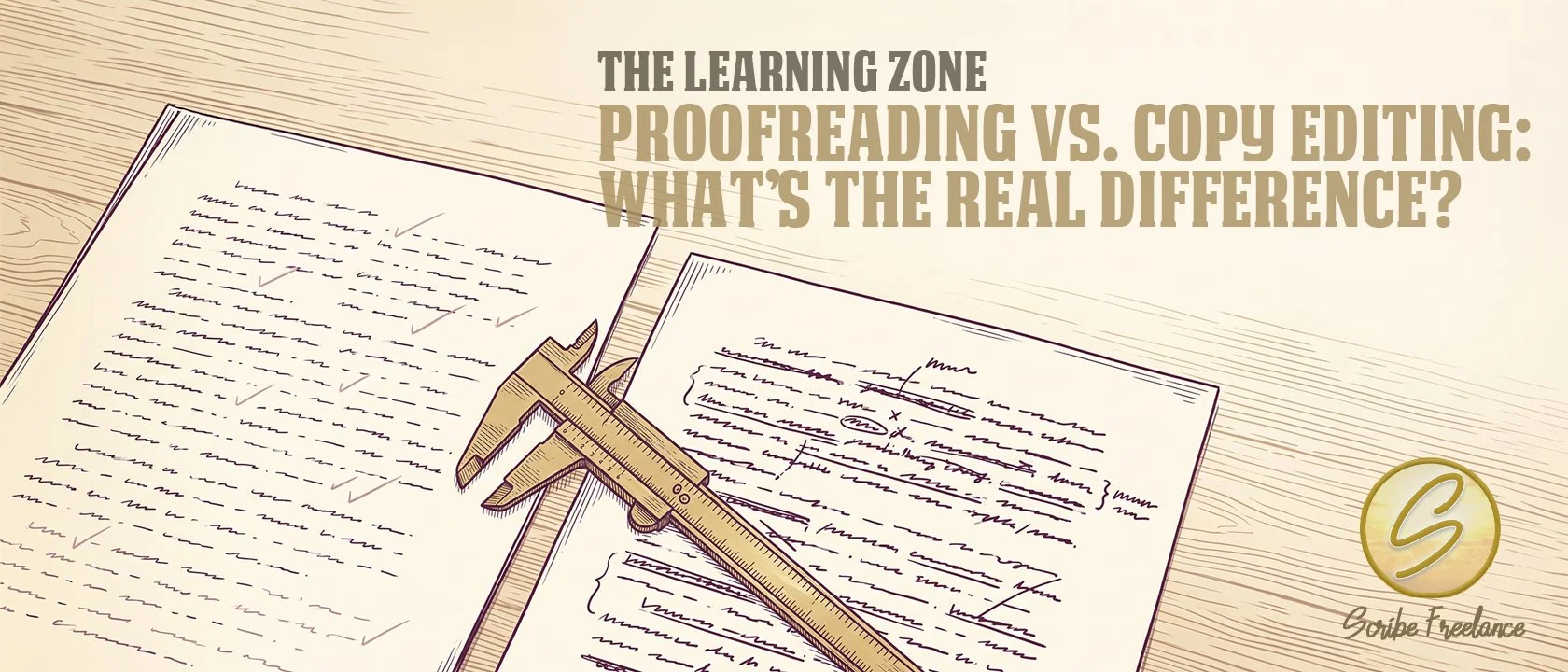
The same manuscript, measured two different ways. One tier checks what’s sitting on the surface. The other measures how deep the sentences themselves still need to go.
You’ve heard proofreading and copy editing used almost interchangeably — sometimes in the same sentence, by the same person. Here’s the real split: a proofread stays on the surface of writing that already works, while a copyedit goes a layer deeper, into the sentences themselves.
I’m Daniel J. Middleton, and close to two decades of book design work has left me with one recurring observation: talent is rarely the problem. Process is.
This article draws the real, checkable line between the two lightest editing tiers, so you can tell which one your manuscript is actually asking for.
Why Do Proofreading and Copy Editing Get Confused?
Both happen late in the process. Both involve someone reading closely and marking things up. From the outside, that looks like the same job wearing two different price tags.
The difference isn’t how closely the editor reads — it’s what they’re allowed to touch. A proofread assumes your sentences already work and checks the surface sitting on top of them. A copyedit assumes the sentences themselves might still need work, and goes in after that.
What Does Proofreading Actually Catch?
Proofreading is the last stop, not a first pass. It’s built for a manuscript that’s already been through revision and shaped into its final form — the kind of writing where the ideas, structure, and voice are settled, and what’s left is surface-level cleanup.
At that tier, a proofread catches spelling, punctuation, grammar, and capitalization errors. It’s the most cost-effective editing option, and it’s the right call for a writer who’s confident in the manuscript itself but wants a final layer of quality assurance before it goes to print or upload.
What it won’t do is touch the writing underneath. If a sentence is grammatically correct but reads awkwardly, or a paragraph’s logic doesn’t quite track, a proofread isn’t scoped to fix that — it’s scoped to catch what’s sitting on the surface of writing that’s already sound.
What Does Copy Editing Actually Catch?
Copy editing is the next rung up, and it works one layer deeper. It covers everything a proofread covers — spelling, punctuation, grammar, capitalization — plus the sentence and paragraph-level work a proofread was never built to touch: style, consistency, and word usage, along with refining phrasing and sentence structure where it’s genuinely uneven.
That’s the tell to watch for. If you catch yourself rereading a sentence because something about the rhythm feels off, but the underlying idea is fine, that’s copyedit territory — not a proofreading fix.
A proofread checks writing that already works. A copyedit steps in when the sentences themselves still need some of that work done.
How Do You Tell Whether Your Manuscript Needs Proofreading or Copy Editing?
The honest test isn’t how finished the manuscript feels to you. It’s the kind of feedback it’s already getting.
I’m running a light proofread right now with an explicit agreement going in: catch the surface errors, don’t touch the phrasing underneath. That boundary holds because the manuscript already earned it. Its beta readers weren’t flagging clunky sentences or inconsistent word choices — just the occasional typo or dropped comma.
If your notes read the same way — small, specific, mechanical — a proofread is probably the right tier. If the notes are vaguer than that, pointing at sentences that don’t quite land or a voice that drifts chapter to chapter, you’re past what a proofread does.
What Happens If You Book Proofreading or Copy Editing at the Wrong Level?
Ordering too light isn’t a service failure — it’s a scope mismatch. If your manuscript actually needed copy editing and you booked a proofread, the uneven phrasing and inconsistent word choices were never in scope to begin with. They won’t get flagged, because catching them isn’t what a proofread is built to do.
Ordering too heavy has its own cost. Paying for copy editing on a manuscript that’s already sentence-level solid means paying for depth the writing didn’t need — real work, just aimed at problems that weren’t there. To see what a proofread actually comes to on a real manuscript, what proofreading actually costs works through the rate in real dollars.
What Should You Do Before You Book Proofreading or Copy Editing?
Pull the most recent feedback on your manuscript — a critique partner’s notes, beta reader comments, or even your own honest reread — and sort it against the two signals above: specific, mechanical issues point to a proofread; uneven sentences and inconsistent phrasing point to a copyedit. If the confusion goes beyond just these two tiers, how to choose the right editing level walks through all four at once. That sort takes a few minutes and saves you from paying for the wrong depth of attention.
If you want to see where your manuscript’s word count lands against actual pricing for either tier, the service rates page breaks both down directly.