

How to Decide Between a Proofread, a Copyedit, a Comprehensive Edit, and a Rewrite
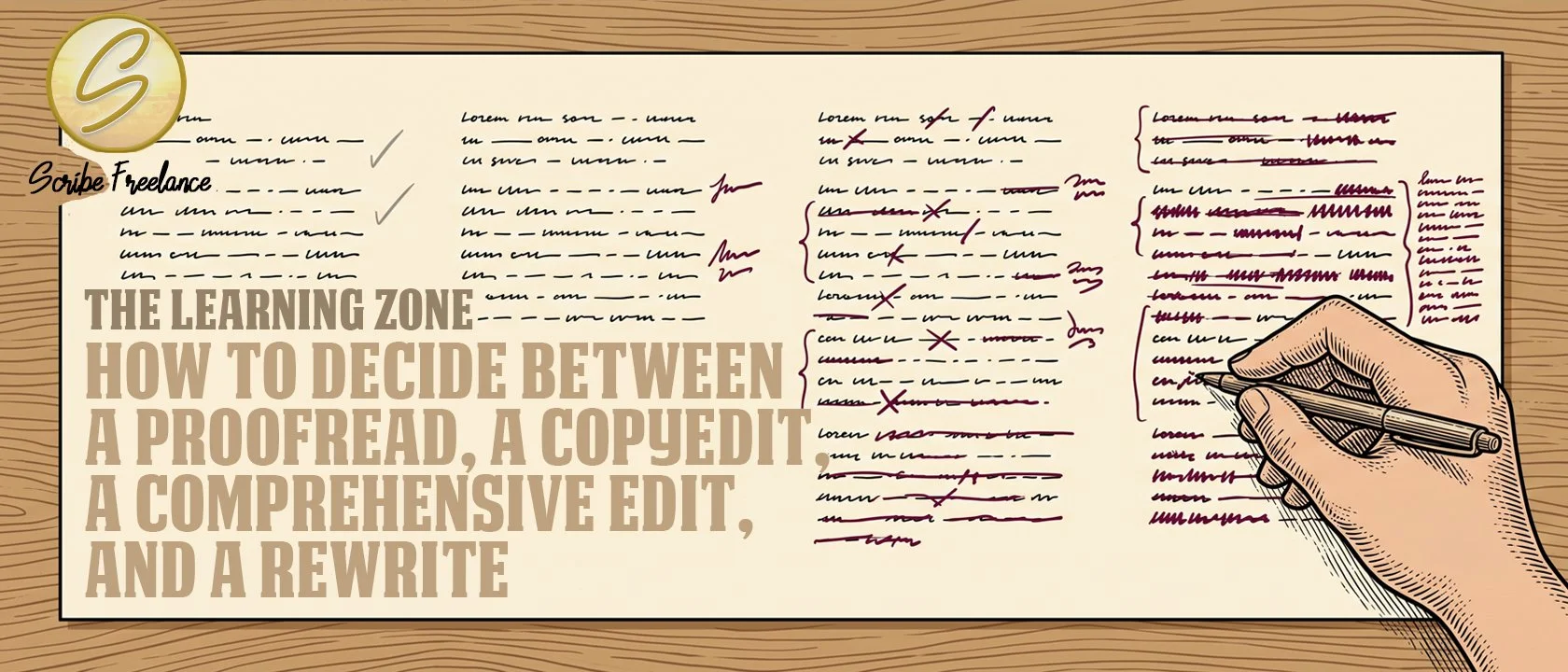
The same paragraph, marked four different ways — from a light pencil check to a full rewrite. The heavier the marks, the higher up the ladder your manuscript needs to go.
You know your manuscript needs editing. What you don’t know is how much. Here’s the short version: the four tiers sit on a ladder, not a menu of four unrelated options, and the fastest way to know which one you need is to look at the kind of feedback your manuscript is already getting, not just how finished it feels to you as the writer.
I caught myself starting to correct sentence-level phrasing on a project that was only scoped for a proofread — the kind of drift that happens when you’re close to the material and see something you could improve, whether or not it’s what was actually asked for. My name is Daniel J. Middleton, and after over two decades in book design and editing, the mistakes I see most often aren’t about talent — they’re about a process nobody explained.
This article isn’t a glossary of four services. It’s a decision aid: the real, practical signals that tell you which tier your manuscript actually needs, so you stop guessing from the name alone.
Why Do the Four Editing Tiers Blur Together?
Because they aren’t four separate services sitting side by side. They’re a ladder, and each rung includes everything below it. A copyedit covers proofreading plus more. A comprehensive edit covers copyediting and proofreading plus more. A rewrite sits above all three.
That changes the actual question. You’re not choosing among four unrelated options. You’re deciding how far up the ladder your manuscript needs to go — which is a much narrower question once you frame it that way.
Is Your Manuscript Actually Ready for a Proofread?
A proofread is the last stop, not the first. It’s built for a manuscript that’s already been shaped, revised, and largely finished, and it exists to catch what’s left: spelling, punctuation, grammar, and capitalization errors sitting on top of writing that already works.
If you’re still asking whether a chapter belongs where it is, or whether a character’s motivation holds up, a proofread won’t touch that. It’s not scoped to. A proofread also isn’t a verdict on whether the earlier edit failed. Sometimes a formatted book comes back with typos an editor missed for a much simpler reason: the file that reached formatting wasn’t actually the fully accepted, final edited version — a dropped set of track changes, an earlier draft sent by mistake — which is a file-handoff problem, not evidence the edit itself missed anything. Either way, a proofread exists to catch what’s actually sitting in the final file, regardless of why it’s there.
When Does a Manuscript Need a Copyedit Instead?
If the writing is basically sound but uneven — sentences that work individually but don’t flow as a whole, inconsistent word choices, a style that drifts chapter to chapter — that’s copyedit territory. A copyedit works at the sentence and paragraph level: grammar, style, consistency, and word usage, refining phrasing and structure rather than just checking it.
The tell is usually pacing. If you find yourself rereading sentences because something about the rhythm is off, but the underlying story or argument is intact, you’re past what a proofread does and not yet into structural territory.
What Does Comprehensive Editing Actually Fix?
Comprehensive editing is where structure enters the picture. This is the tier for a manuscript where individual sentences might read fine, but something larger isn’t working — pacing that drags in the middle third, a chapter that would land better two spots earlier, an argument that circles back on itself instead of building. It reworks passages for clarity and flow and addresses those structural issues directly, on top of everything a copyedit and proofread already cover.
The signal here is usually a reader — a critique partner, a beta reader, an early reviewer — saying something is off but not being able to point to a specific sentence. That vague, structural kind of feedback is a comprehensive-edit signal, not a copyedit one.
When Does a Manuscript Need a Full Rewrite?
A rewrite is the tier authors are usually most anxious about, because it sounds like starting over. It isn’t. A rewrite reshapes ideas into more polished, engaging prose while preserving the author’s actual voice, and it’s reserved for manuscripts that need extensive revision, not manuscripts that are simply rough around the edges.
The honest signal is scale. If the notes coming back describe entire sections needing to be reconceived, not adjusted, or if the ideas are strong but the execution consistently isn’t landing them, that’s a rewrite conversation, not a heavier copyedit.
How Do You Actually Diagnose Which Tier Fits?
Look at what kind of feedback your manuscript has been getting, not just how it feels to you as the writer:
Feedback about specific errors — typos, grammar slips, inconsistent capitalization — points to a proofread.
Feedback about the writing itself — clunky sentences, inconsistent voice, word choice that pulls a reader out of the page — points to a copyedit.
Feedback about the shape of the whole thing — pacing, structure, an argument or story that doesn’t build the way it should — points to a comprehensive edit.
Feedback that the manuscript isn’t there yet at the idea level — strong material that isn’t landing in its current execution — points to a rewrite.
None of these require you to guess. They’re visible in the kind of notes you’re already getting back, if you read them for pattern rather than reacting to each one individually.
Each tier includes the one below it, so the real question isn’t which of four separate services fits — it’s how far up that ladder your manuscript actually needs to go.
What Should You Do With Your Own Manuscript Right Now?
The next decision isn’t which service to book. It’s which category the feedback you already have actually falls into. Pull your last round of notes, whether that’s from a critique partner, a beta reader, or your own reread, and sort it against the four signals above before you assume you know which tier fits.
If you want to see where your manuscript’s word count lands against actual pricing once you have an idea which tier fits, the service rates page breaks down the cost for each of the four tiers directly.