
Simple, Medium, or Complex Ebook: What Actually Determines the Tier?
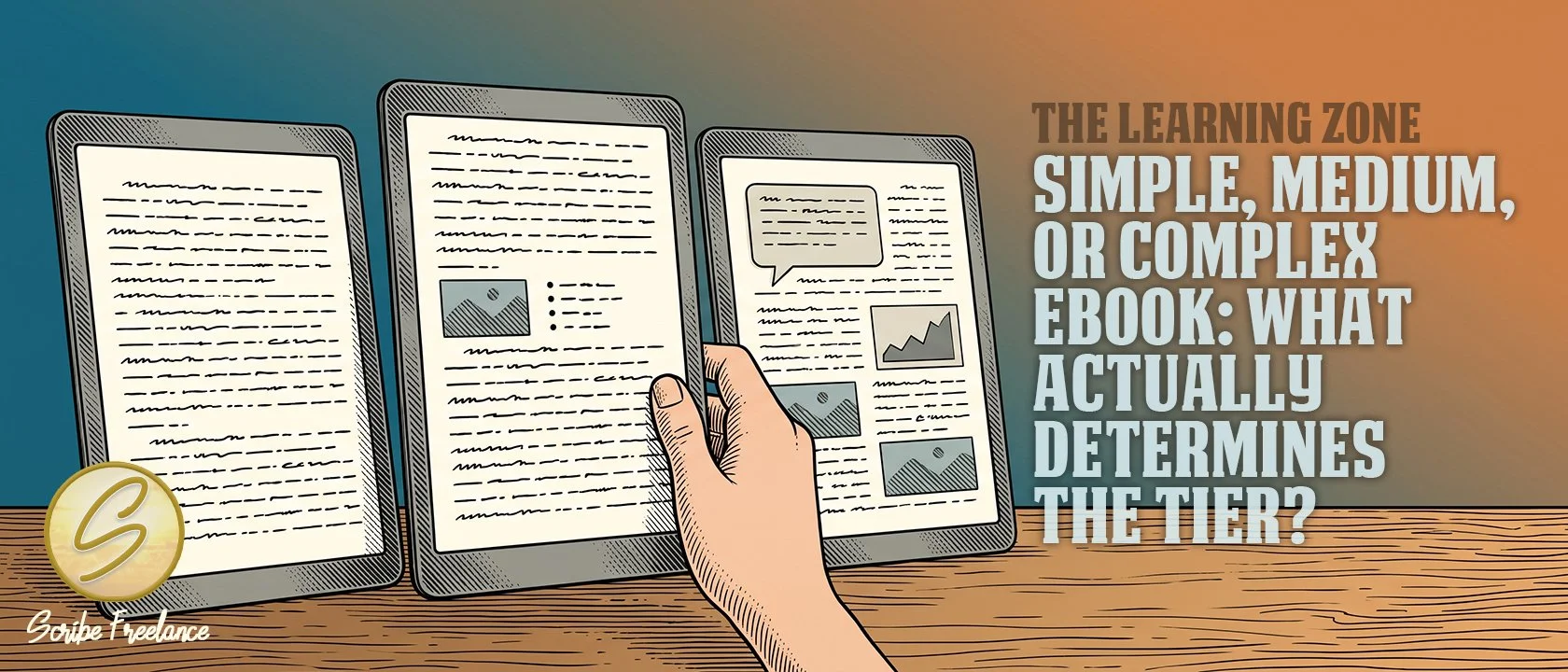
The extra per-page rate isn’t about the words on the screen — it’s about how many elements the reflow has to hold onto as the reader resizes it.
Most authors assume ebook pricing tracks the same logic as print — length in, price out. It doesn’t: the tier comes down to how many layout elements the file actually has to hold, not how many words are in it.
I’m Daniel J. Middleton, and for over two decades I’ve helped indie authors and small presses turn raw manuscripts into finished books they’re genuinely pleased to stand behind.
This piece breaks down what actually separates Simple, Medium, and Complex ebook tiers, using the real definitions behind the rate card, and the one signal that decides which tier a given manuscript needs.
What Actually Separates a Simple, Medium, and Complex Ebook?
Simple ($0.75 per page) is straight, text-based flow — a novel or a text-only nonfiction manuscript with no embedded elements competing with the prose for layout attention.
Medium ($1.25 per page) adds lists and some images into the running text. Nothing dense enough to need custom placement decisions on every page, but enough recurring elements that the file isn’t pure flowing text anymore.
Complex ($2.50 per page) covers callouts, numerous images, and specialized formatting — the kind of manuscript where a meaningful share of pages need their own layout call, not the same repeated decision applied straight through.
Why Does an Ebook Quote Come Back Higher Than Expected?
Because the print quote and the ebook quote solve two different problems on the same manuscript. Print formatting places content on a fixed page. Ebook formatting makes that content reflow correctly across dozens of screen sizes, fonts, and reader settings — the same underlying mechanics covered in what actually goes into an EPUB file — and every element that isn’t plain paragraph text makes that reflow harder to get right.
What Should Actually Drive the Ebook Tier Decision?
Not genre, and not file length. The real question is how many elements in the manuscript need to survive being reflowed onto a screen the reader controls, not a page the designer controls.
A novel with dialogue and scene breaks reflows cleanly no matter what device it lands on — that’s Simple. A memoir with a handful of photos and a bulleted list of milestones has real elements to carry, but not so many that every page is a fresh decision — that’s Medium. A book with charts, sidebars, or graphics that have to stay positioned relative to specific text is a different job entirely — that’s Complex.
What Ebook Tier Did a Real Project Actually Need — and Why?
The Inheritance of Shadows: A Family’s Reckoning (Charles Enea) is a manuscript I quoted, not one that went forward — still a useful example, since the tier call works the same either way. At 400,000 to 500,000 words, close to 800 print pages at 6×9, with family-tree graphics, images, and mixed-format sections built from letters and document excerpts but no complex tables, the ebook quoted out at Medium — not Simple, not Complex.
Not Simple, despite reading like flowing narrative nonfiction for most of its length — the mixed-format sections and images were enough recurring, non-text content that the flat text-based rate wasn’t the right fit. Not Complex either, despite family-tree graphics sounding like exactly the kind of asset that tier is built around — nothing in the file needed callouts or the page-by-page calls Complex is priced for.
The tier itself never moved past Medium. The total did — at close to 800 pages, even a modest per-page rate adds up to a real number, and there’s no way around that math on a manuscript that size. I’d priced this one from a phone call before seeing the full file and left the ebook line item off the initial quote; I circled back with a corrected estimate once I saw what the manuscript actually was.
A tier decision isn’t measuring how long or how impressive a manuscript is — it’s counting how many pages ask for a decision beyond one repeated template.
What Does the Price Jump Between Ebook Tiers Actually Buy?
The step from Simple to Medium is real but modest — $0.50 more per page for placing images and lists correctly across reflow. The step from Medium to Complex is bigger, exactly double the rate, because specialized formatting means re-solving a layout problem on a meaningful share of the book’s pages instead of applying one template straight through.
Neither jump is arbitrary — each tracks the actual number of pages that need their own decision, not a flat markup for looking more complicated.
What Should You Check Before You Order Ebook Formatting?
Look at the manuscript for anything beyond flowing paragraphs — images, lists, a chart or graphic, callouts, or sections that shift format partway through. If any of that shows up more than occasionally, the file is very likely Medium or Complex, regardless of genre or page count. If it’s straight prose front to back, Simple is the honest fit, and there’s no reason to pay for more than that.
Worth knowing, too: the cover, interior, and ebook tiers on a given book get decided independently of each other. A Standard cover doesn’t mean a Simple ebook, and a Nonstandard interior doesn’t automatically carry over to a Complex one — each format is solving its own layout problem, not inheriting the tier a sibling format landed on.
If you want to see exactly where your manuscript lands, the service rates page breaks down all three ebook tiers, plus the cover and interior tiers alongside them, in one place.