

Nonstandard or Text-Only Interior: What Actually Separates Them?
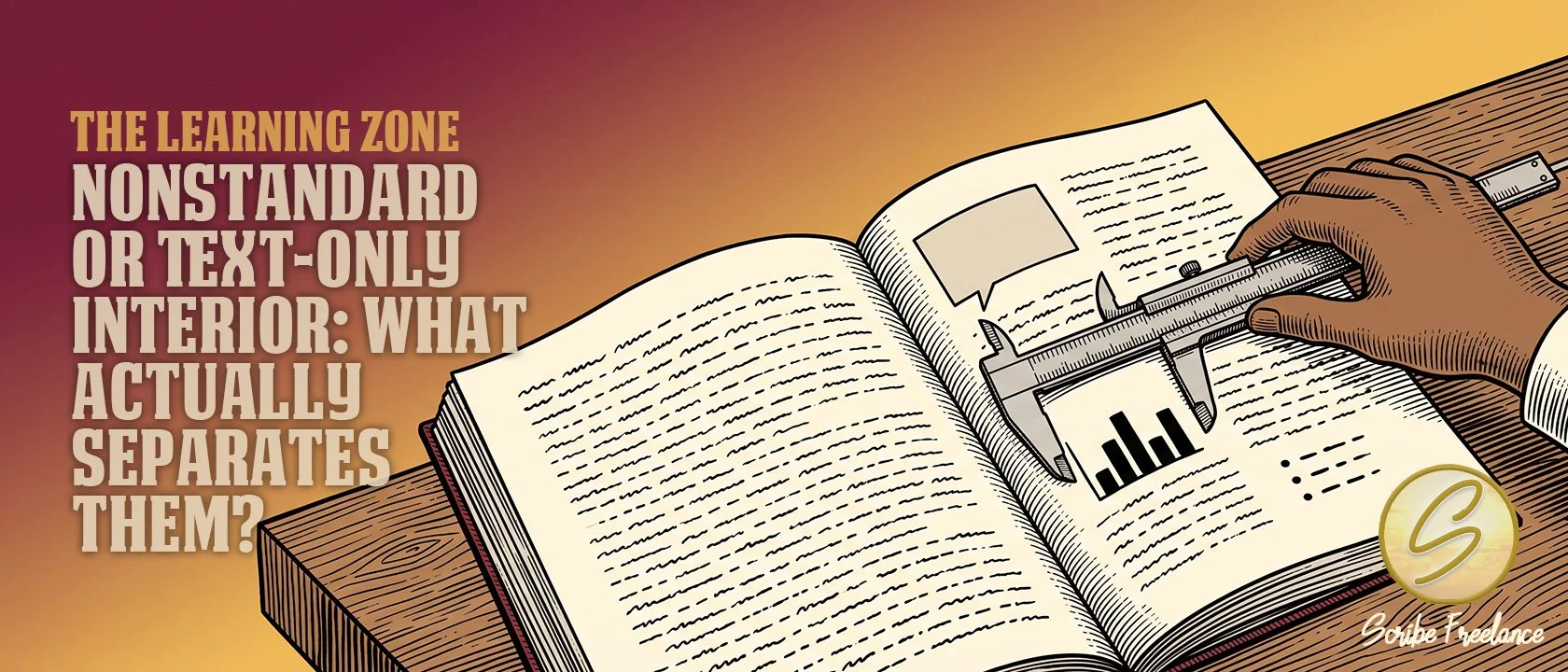
The extra per-page rate isn’t about what’s printed on the page — it’s about how many times that page asks for a new design decision.
A Text-Only interior is priced by length — straight-flowing prose, one consistent layout decision applied page after page. A Nonstandard interior is priced by complexity — sidebars, charts, tables, or lists that each need their own placement decision. Most authors assume “nonstandard” means unusual, and don’t realize which one their own book actually is.
I’m Daniel J. Middleton, and I’ve been designing books for authors and publishers for close to twenty years now — the part I still love most is finding the design that makes an author’s message land.
This piece draws the real line between a Nonstandard and a Text-Only interior, using the actual rate-card definitions, and the one thing that actually decides which one a manuscript needs.
What Actually Separates a Nonstandard and a Text-Only Book Interior?
Text-Only Interiors are priced by length: $3.00 per page up to 299 pages, $2.75 per page from 300 to 499 pages, and $2.50 per page at 500 pages or more. This tier covers novels and text-based nonfiction — typeface selection, line spacing, and consistent formatting, with no embedded complex elements.
Nonstandard Interiors cover two different things. Children’s books, up to 40 pages, run a flat $500 fee. Everything else that qualifies runs $4.00 per page, based on the final layout page count. That complex-elements rate is the one that catches authors off guard — it covers image-rich nonfiction and any manuscript integrating images, charts, graphs, tables, bulleted and numbered lists, subhead density, and other items into the running text.
Why Do Authors Get Blindsided by Which Interior Tier Their Book Needs?
Because “nonstandard” sounds like it’s sorting unusual books from ordinary ones, and most authors don’t think their book is unusual. A lot of ordinary nonfiction lands in the Nonstandard tier anyway — memoir with pull quotes, a how-to book with a numbered process list, or a manuscript that reads as straight text until it turns out every chapter is broken into a run of subheads.
The real dividing line isn’t fiction versus nonfiction, and it isn’t short versus long. It’s whether the book has elements that each need their own layout decision, or whether the text just needs to flow cleanly from one page to the next.
What Should Actually Drive the Interior Tier Decision?
A callout box, a chart, a table, a bulleted list, or a subhead breaking up the narrative each has to be placed, sized, and balanced against the surrounding text on its own terms. A novel’s manuscript, however long, mostly needs one consistent decision applied down every page: typeface, spacing, margins, repeat.
That’s the actual test — not “is this book weird,” but “does every page make the same decision, or does this page make several?”
Nonstandard doesn’t mean unusual — it means every element on the page needs its own design decision.
What Interior Tier Did a Real Project Actually Need — and Why?
Greatness Is a Verb, which highlights a life of success through service, is the same project behind the cover-tier piece — a self-help and memoir hybrid built around Keith Sodan’s own coaching tools and frameworks, written with Mike E. Brown and brokered through John Clark.
I quoted it at the Nonstandard complex-elements rate, not the flat Text-Only per-page rate — and the reason wasn’t images, charts, or tables. A handful of bulleted lists show up here and there, but they’re not what pushed the tier decision either. It was subhead density.
Eighteen chapters, each broken into three or four subheads at minimum, some running well past that, carry Keith’s personal story and coaching framework through the narrative chapter by chapter. Every one of those subheads is its own placement and spacing decision, repeated dozens of times across the book.
The manuscript actually came in shorter than the original 75,000-word estimate — the tier decision tracked what the page itself had to hold, not how long the book turned out to be.
What Does the Price Difference Between Interior Tiers Actually Buy?
The jump from roughly $3.00 per page to $4.00 per page looks small written out, but it’s tracking a real difference in scope. A Text-Only layout applies one template consistently for hundreds of pages in a row. A Nonstandard layout re-solves a design problem every time a new element shows up — where a callout sits relative to the paragraph it supports, how a chart survives a page break, whether a list needs its own visual weight or would compete with a nearby sidebar, or whether a subhead breaks awkwardly from the sentence introducing it, stranded on the far side of a page break when the two are supposed to sit together.
Neither rate is arbitrary. One prices repeatable work. The other prices work that has to be re-decided page by page.
What Should You Check Before You Order Interior Design?
Look at your manuscript for anything beyond flowing paragraphs — sidebars, pull quotes, charts, tables, numbered steps, embedded images, or a chapter structure broken into frequent subheads. If any of that shows up more than occasionally, the book is very likely Nonstandard, regardless of genre or length. If it’s straight prose from front to back, Text-Only is the honest fit, and there’s no reason to pay for more than that.
If you want to see exactly where your manuscript lands, the service rates page breaks down both interior tiers, plus the cover and ebook tiers alongside them, in one place.